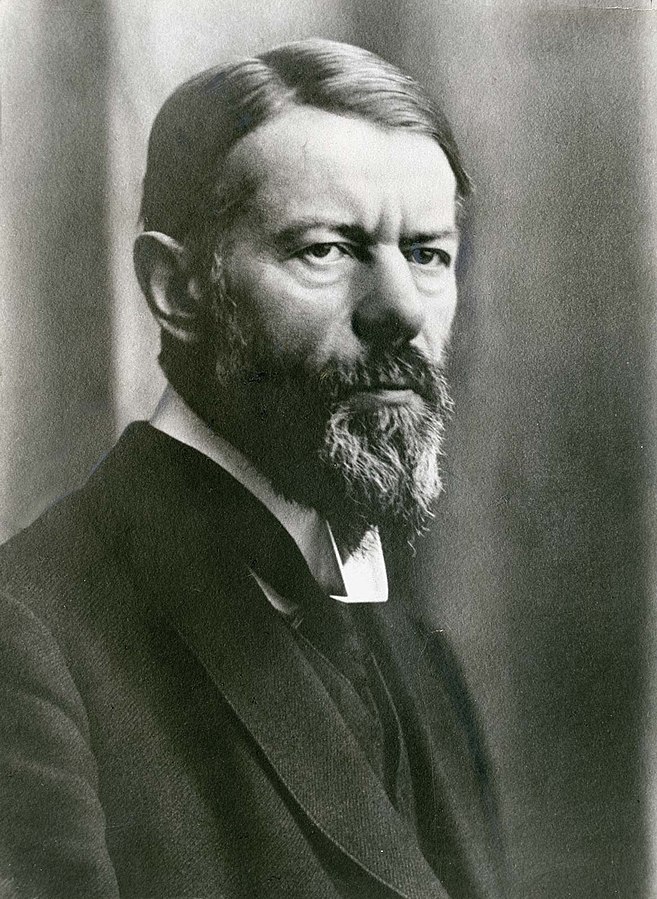
Why people recognize authority
Weber distinguished traditional, charismatic, and rational-legal domination. In the first case, the basis is an accepted custom; in the second, belief in a leader’s exceptional qualities; in the third, recognition of an established order and the authority of an office. Real organizations may combine different foundations.
For a manager, this makes it possible to distinguish personal influence from formal competence. An employee may respect a colleague’s experience, but the right to approve a decision belongs to another role. Mixing these foundations creates uncertainty: whose advice is binding, and who is responsible for the consequences?
What bureaucracy means for Weber
Weber described the ideal type of bureaucracy as an analytical model, not as praise for red tape. “Ideal” here does not mean “perfect”: the model identifies characteristic features for comparison with reality. The main principles of his organizational analysis are presented in the posthumously published work Economy and Society.
Main features of the model
- Defined duties and areas of competence.
- A hierarchy of positions and a system of supervision.
- Written rules and documentation of decisions.
- Professional qualifications of employees.
- Separation of the position from personal property and interests.
- Application of rules without personal favoritism.
Illustrative example: a decision route based on established authority
A modern training scheme for approving a purchase. It demonstrates the application of rules and official competence, rather than Weber’s original scheme.
| Step | Role | Basis for the decision | Outcome |
|---|---|---|---|
| 1. Submit a request | Initiator | Description of the need and justification | Registered request |
| ↓ 2. Check the data | Person responsible for completeness | Agreed list of information | Forwarding or return with a reason |
| ↓ 3. Check the budget | Budget owner | Available budget and purpose of expenditure | Approval or justified refusal |
| ↓ 4. Approve | Authorized manager | Limits of authority and procurement criteria | Recorded decision |
| ↓ 5. Execute | Purchaser | Approved need | Order and confirmation of execution |
If the approver is absent, the decision is transferred to an officially appointed deputy, not to any available employee. Identical requests are evaluated according to identical criteria; a refusal is explained. At the same time, the scheme itself does not justify unnecessary approvals: each step should have a clear purpose.
Training example: purchase approval
Suppose identical purchases are approved differently within a company. One manager accepts an oral request, another requires several emails, and a third postpones the decision until a personal meeting. Employees begin looking for an approver they know instead of preparing a justification.
A modern reading of Weber’s ideas suggests shifting the basis of decisions from personal relationships to defined criteria. For a pilot, one type of purchase is selected, and the required data set, the approver’s competence, the review period, and the process for challenging the decision are described. This is an example of organizational design, not a ready-made regulation by Weber.
| Element of the order | What it changes |
|---|---|
| Authority of the role | It is clear who has the right to approve a request of a particular type. |
| Decision criteria | Comparable requests are considered on the same grounds. |
| Record of justification | It is possible to reconstruct why the decision was made. |
| Substitution procedure | The absence of a particular person does not block the entire process. |
| Exception review | A nonstandard case is assigned to a responsible person and receives an explainable decision. |
How to prepare rules that can actually be used
First, examine several real situations. What data is truly needed? Where does the approver’s authority end? What should be done if the budget is confirmed but there is only one suitable supplier? Such questions help separate necessary checks from habitual formalities.
After describing the procedure, conduct a trial review with employees. Give them identical training requests and ask them to explain the decision route. If participants choose different paths, clarify the rule. If the route is clear but requires information that cannot be obtained, revise the requirements.
Does impersonality mean indifference to the person?
No. In an organizational sense, it means that a decision is independent of personal sympathy or kinship. In a training process, an employee should receive a clear explanation for a refusal and an opportunity to correct the data. Equal application of rules is compatible with respectful communication.
How to distinguish order from excessive formalism
- Each check has a clear purpose.
- Data is not requested repeatedly without necessity.
- The responsible person and review period are known.
- An exception does not require secretly bypassing the system.
- A decision can be explained and reviewed through the established procedure.
For the pilot, monitor timelines, returns, the number of exceptions, and differences in decisions on comparable requests. Do not assess the quality of the process solely by the number of fields completed. An additional signature is useful only when it solves a specific control task.
Limitations of the model
Rigid procedures may account poorly for new circumstances. A narrow scope of authority can sometimes lead to a situation in which everyone has completed their own step, but no one has helped achieve the overall result. The modern management challenge is to preserve predictability and traceability while leaving an organized path for change.
Does a small team need this kind of logic?
Yes, but the amount of formalization can be small. For a training process, an agreed rule, a list of authorities, and a record of important decisions are sufficient. The size of the document does not determine the quality of management.