Production needs the material on Thursday. Procurement expects to receive it on Wednesday, the supplier promised to “ship during the week,” and the warehouse has not received any information yet. On Tuesday, it becomes clear that a truck has not yet been assigned. Formally, the purchase is being handled, but no one can say when the material will become available for work.
Control over the deadline is lost long before a delay occurs. This happens when the date exists only in an email, its meaning is understood differently by different people, and a change to the arrangement does not reach those who are building their plans around it. Employees start finding out what is happening only when there is almost no time left for an alternative solution.
Why a Date in Correspondence Does Not Yet Mean Delivery Is Under Control
The same date may refer to different events. Production identifies the day when the material is needed for work. The supplier reports the shipping date. Procurement enters it as the expected delivery date. Transportation, unloading, and acceptance take place between these events, but the difference is not visible in the overall plan.
Changes remain with one participant. The supplier postponed the shipment during a phone call. The procurement specialist knows the new deadline, while production continues to rely on the previous one. Even a message received in time does not help if the shared request information has not been updated.
It has not been defined who checks the promise. The invoice has been paid and the request is being processed. One employee believes the logistics specialist will confirm the date; another is waiting for a message from the supplier. The purchase has an assigned person, but the specific action of checking an approaching delivery has not been agreed upon among the participants.
All open purchases have to be compiled manually. To see the nearest deliveries, a manager has to combine employees’ spreadsheets and check correspondence. While the information is being collected, some of it changes. The discussion turns into reconstructing facts instead of choosing actions.
How Delivery Uncertainty Turns into a Production Disruption
An unconfirmed date gets into the production plan. Personnel and equipment are prepared for it. When a message arrives that the delivery has been postponed, work that has already been prepared has to be reorganized.
A supplier’s delay may be objective. But the impact also depends on when the company learns about the risk. Early notification makes it possible to check a partial delivery, agree on an acceptable substitute, or reschedule an operation. Late notification leaves fewer options and affects work that has already been prepared.
Trust in the data also suffers. If the stated date regularly differs from reality, employees stop using the shared list and return to personal calls. The number of clarifications increases, but the overall picture does not become more accurate as a result.
What Exactly Needs to Be Controlled
Before changing the program or introducing a new report, agree on what the dates mean. For one purchase, these are different control events, not interchangeable values.
| Event | Question it answers | What needs to be clarified |
|---|---|---|
| Production requirement | When must the material be available for work? | The required quantity and the consequences of its absence at that point. |
| Supplier shipment | When will the goods be handed over for transportation? | Confirmation of shipment, batch contents, and transportation terms. |
| Arrival at the company | When are the goods expected to arrive at the delivery address? | The current arrangement, transportation, and readiness for unloading. |
| Availability after acceptance | When can the received goods be used? | Completeness, required checks, and identified discrepancies. |
It is not necessary to create a complex system for every standard purchase. However, participants must understand the meaning of the date field being used in the same way. For critical materials, separate control events and the necessary time buffer should be defined explicitly.
Check the Nearest Open Deliveries
- Is the responsible person and the requesting department clear for each purchase?
- Does the stated date mean arrival, shipment, or the production requirement?
- Has the expected deadline been confirmed, or does it remain a preliminary assumption?
- Is a change to the deadline visible to those whose work depends on the material?
- Is it clear who will clarify the next critical delivery and when?
- If the delivery is postponed, is it known who decides on further action?
If the answers can be found only after several phone calls, the issue is not necessarily a lack of discipline. The information may simply have nowhere to be collected in a convenient form for everyone, and the procedure for updating it may not be defined.
How to Organize Delivery Management in OpenBox
The “Request Management” solution provides a shared record that can link a department’s requirement, the responsible person, the purchase, and the delivery. Instead of separate lists, participants get a request register with search, filters, and sorting. Access to the records is determined by the configured permissions.
A request can include the counterparty, invoice number, amount, delivery location and date, and driver. This information remains alongside the original requirement. The manager and requester can refer to the same record, while the procurement specialist does not need to repeat all the details to each participant.
One Request: From Requirement to a Change in the Delivery Date
A sample workflow. Swipe through to follow the participants’ actions.
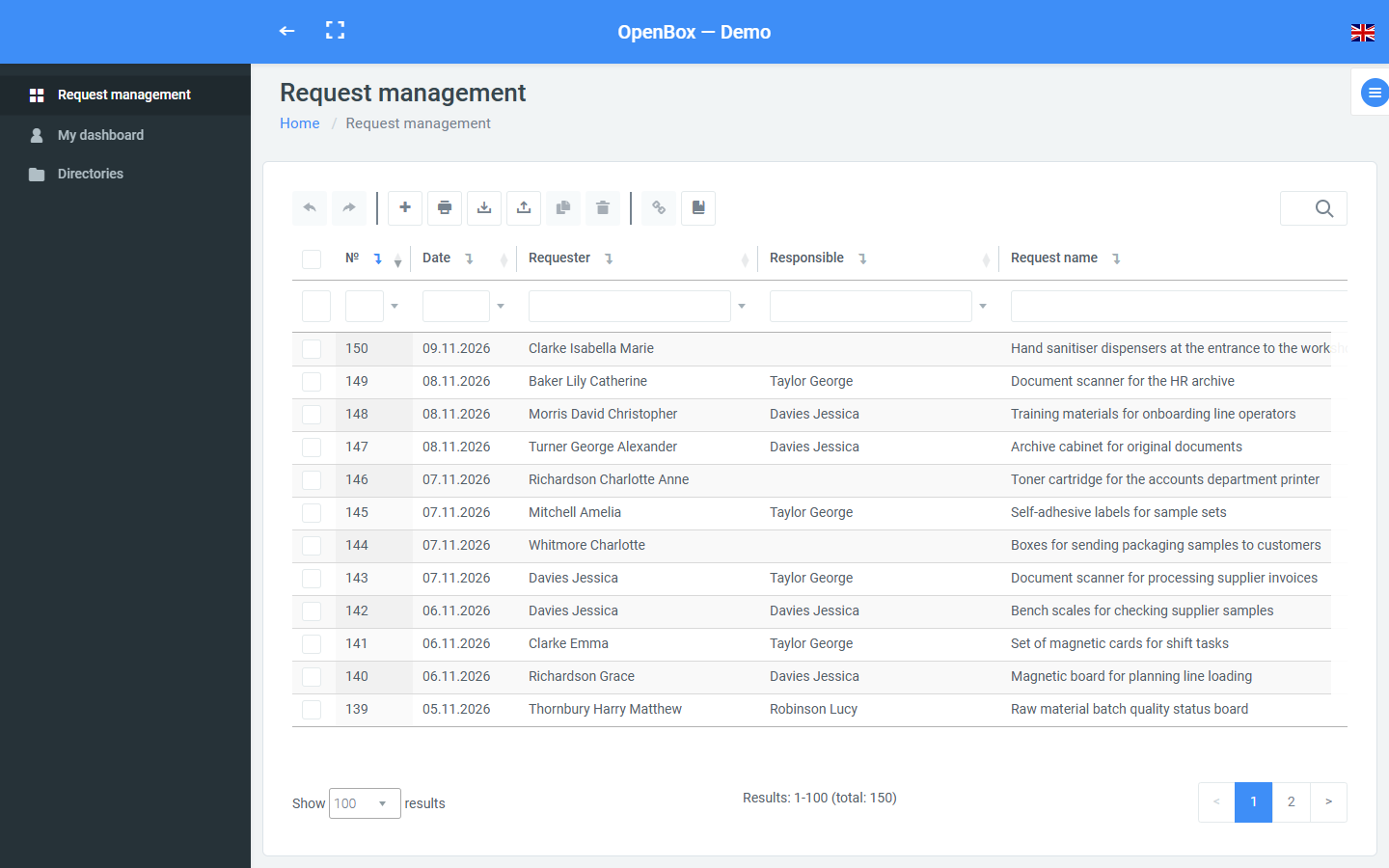
The main benefit of this approach is access to up-to-date information. The request shows who is handling the purchase and what delivery information has been entered. The required records can be selected for discussion and the selection can be exported. The result depends on whether participants update the data and use it when making decisions.
The program does not confirm the deadline on behalf of the supplier.
The presence of a date field does not mean automatic cargo tracking, receipt of the carrier’s status, or the sending of overdue warnings. In the basic scenario described, the responsible person checks the arrangements and updates the record. Additional dates, notifications, and integrations must be agreed separately when configuring the solution.
Explore the Solution for Managing Requests and Deliveries
If expected deadlines have to be clarified from scratch every day, start with a shared register and clear rules for updating the data. The “Request Management” page presents OpenBox capabilities, the interface, and the request journey from creation to delivery. You can also proceed to a demo there and check whether this approach is suitable for your company.