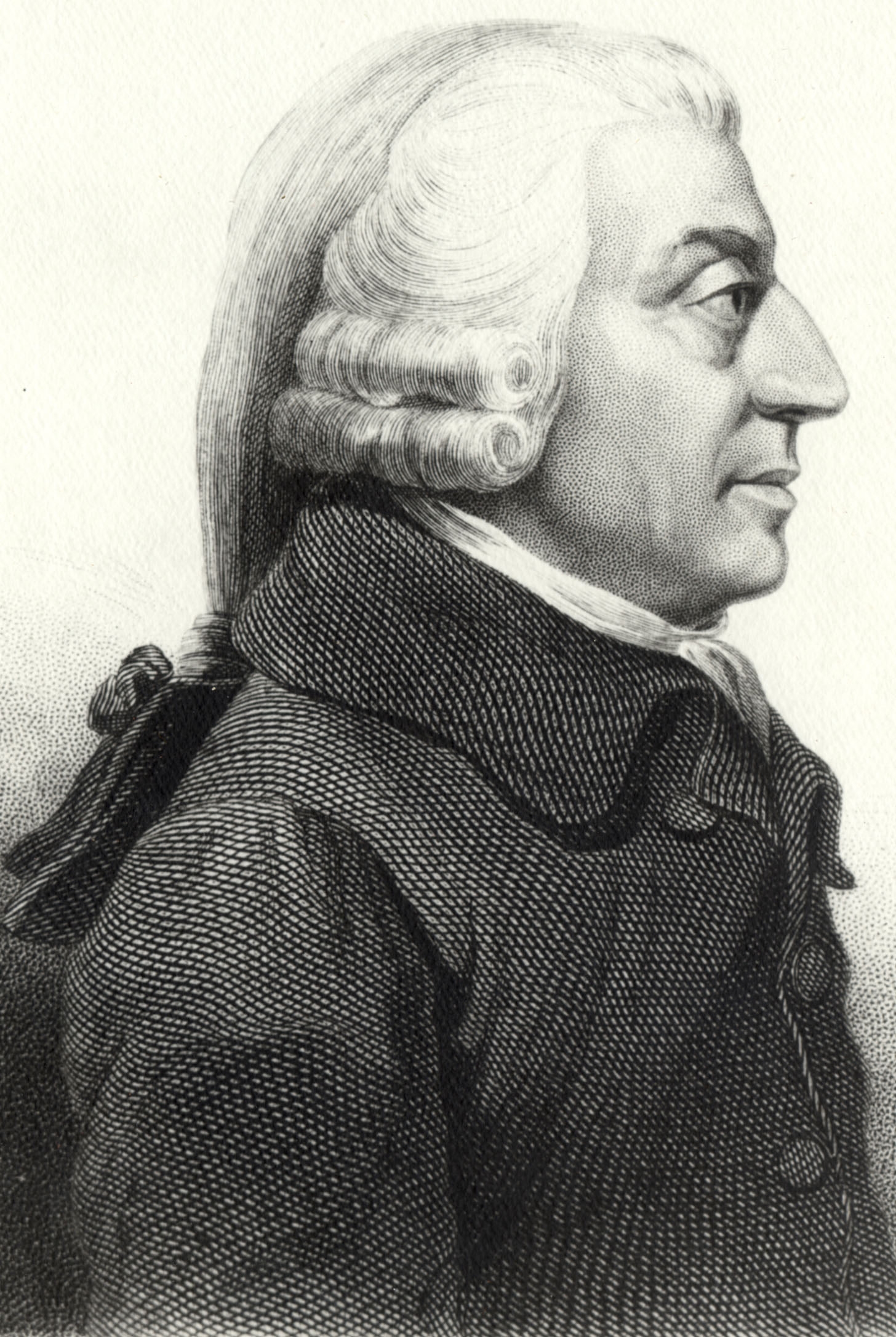
Why Smith Is Included in the “Management Gurus” Section
Smith did not create a system of corporate management in the modern sense. He studied the structure of economic life and the moral foundations of human behavior. His inclusion in a management library is connected to the fact that questions of specialization, aligning interests, and organizing joint work remain important for managers.
Biographical information and the history of Smith’s teaching are presented in materials from the University of Glasgow. Below, historical ideas are separated from modern examples of their management interpretation.
Two Books — Two Interconnected Areas
| Work | Main areas of focus |
|---|---|
| “The Theory of Moral Sentiments,” 1759 | Moral judgments, the ability to take other people’s feelings into account, and the perspective of the “impartial spectator.” |
| “An Inquiry into the Nature and Causes of the Wealth of Nations,” 1776 | Division of labor, exchange, capital accumulation, income distribution, and economic policy. |
The first book should not be ignored when reading the second. Viewing Smith as an author who explained all behavior exclusively through selfishness impoverishes his ideas. Overview of moral philosophy: University of Glasgow — an exhibition of Adam Smith’s works.
Division of Labor: Why Specialization Increases Output
At the beginning of The Wealth of Nations, Smith examines the manufacture of pins. Production is broken down into operations: drawing and straightening the wire, cutting it, sharpening it, making and attaching the head, and other actions. Participants perform separate parts of the overall work instead of each worker making the entire product.
Three Mechanisms of Productivity Growth
- Skill development: repeating a particular operation increases the performer’s dexterity.
- Fewer switches: time losses are reduced when moving between different tasks.
- Improvement of tools: devices and machines emerge that make operations easier to perform.
Limits of Specialization
In Book I, Chapter III, Smith links the possibilities for the division of labor to the size of the market. Narrow specialization requires sufficient demand for its output. If the volume of work is small, assigning a separate performer to each operation may prove unjustified.
In Book V, he also discusses the negative consequences of reducing human labor to a small number of simple actions and the importance of education. It would therefore be incorrect to read Smith as an advocate of endlessly fragmenting every task.
Illustrative Example: The Division of Labor in Pin Manufacturing
A modern educational diagram based on Smith’s example. It shows aggregated operations rather than a complete historical description of production. The number of workers and output figures are not specified here.
One Craftsperson Performs the Entire Cycle
Prepare the wire → cut it → sharpen it → attach the head → finish and package
One person switches between tools and types of work.
The Work Is Divided Among Participants
| Station | Operation | What is passed on |
|---|---|---|
| 1 | Wire preparation and straightening | Prepared wire |
| ↓ 2 | Cutting blanks | Blanks of the required length |
| ↓ 3 | Sharpening | Blanks with a point |
| ↓ 4 | Making and attaching the head | Assembled pin |
| ↓ 5 | Finishing and packaging | Finished product |
How Can the Example Be Applied to Office Work?
A similar analysis can be conducted for an order: data intake → technical review → calculation → approval → documentation. First, measure waiting times and returns. Dividing the work into five stages does not mean that five separate employees are necessarily required.
Educational Example: Organizing Order Processing
Suppose a small company receives orders for standard products. Each manager independently checks whether the application is complete, clarifies the technical parameters, calculates the price, and prepares the documents. Constant switching creates delays and repeated requests for clarification.
The team considers specialization: assigning the initial check to a separate role, giving the technical assessment to a specialist, and preparing documents based on the agreed data. Before changing the structure, it observes actual orders and records processing time, waiting times, and returns.
| Potential Benefit | New Risk | What to Check in the Pilot |
|---|---|---|
| Repeated checks are completed faster. | Orders accumulate before the sole checker. | The queue, workload, and possibility of substitution. |
| Technical questions are handled by a specialist. | The specialist receives incomplete information and returns the tasks. | The data provided and the reasons for returns. |
| Documents are prepared consistently. | The employee fails to notice nonstandard order conditions. | The procedure for handling exceptions and the number of corrections. |
For the pilot, one type of order can be selected. The comparison should cover the entire period from receiving the request to delivering the completed quotation, not just the speed of individual roles. If documents are prepared faster but waiting for the technical assessment increases, improvement of the overall process has not yet been demonstrated.
Participants’ Interests and the Overall Outcome
Smith explains exchange through people’s ability to take the interests of the other party into account. For a modern manager, this is a useful starting point for discussing incentives, but it is not proof that any individual metrics will automatically align with one another.
In the educational example, a bonus based solely on the number of applications passed on may encourage the first role to send incomplete tasks. Therefore, the team discusses speed, the quality of input data, and the final order outcome together. This is our example of applying the idea, not an incentive system from Smith’s works.
Does the “Invisible Hand” Mean That Management Is Unnecessary?
No. Smith’s reasoning about the unintended consequences of economic actions cannot be turned into a universal guarantee that any process will be coordinated. It does not follow that a company can dispense with the distribution of responsibility, quality checks, and rules of interaction.
How Does Smith Differ from Taylor?
Smith studied the division of labor and economic exchange in the eighteenth century. Frederick Taylor later developed scientific management of work operations. Smith should not be credited with Taylor’s system of setting work standards or with modern project management tools.
Questions for Discussion with the Team
- Where do employees constantly switch between different types of work?
- Which operations actually benefit from specialization?
- Is there enough task volume for a separate role?
- How is the result handed over, and who is responsible for exceptions?
- What will happen when a narrow specialist is absent?
- How can the result for the customer be measured while preserving opportunities for employee learning?