The supply plan has been approved and orders have been sent to suppliers. But in the morning, Manufacturing asks for components to be purchased urgently; by lunchtime, the maintenance department needs a spare part; and in the evening, it turns out that another request should have been included in Procurement a week earlier. The procurement specialist switches between calls, emails, and messages. Planned tasks are pushed aside, even though their deadlines have not been changed.
An individual urgent purchase is a normal part of an enterprise’s work. The problem arises when exceptions become a daily routine: priority goes not to the most well-founded need, but to the one people remind others about most insistently.
How to Tell That Urgent Procurement Is Already Controlling Your Plan
Look at how the last several unplanned purchases went. Did the procurement specialist have to search through correspondence for the original request? Clarify the quantity and delivery location after work had already begun? Find out who was already handling the matter? Answer several employees asking the same question about its status?
If these actions are repeated, some of the time is spent not on Procurement, but on reconstructing information. Employees may be conscientiously doing their jobs, but the overall process remains dependent on the memory and availability of individual people.
A telling sign is that the manager can see a list of urgent purchases but cannot quickly understand which requests have not yet been taken up, who is responsible for the rest, and which deliveries are expected.
Why Needs Turn into Urgent Requests
There Is a Request, but No Shared Record of It
The foreman reported a need by phone, an employee sent a message, and a manager forwarded an email from a supplier. Each person believes the task has been passed on. But until requests are collected in one register, it is impossible to confidently verify that the list is complete. An overlooked need returns later—with a demand to purchase it immediately.
The Request Arrives Without the Information Needed for Procurement
“Bearings are needed for a repair” is not yet sufficient grounds for placing an order. The exact name, quantity, unit of measurement, and explanation of the need are required. If this information is collected through several calls, the time spent clarifying details reduces the remaining Procurement lead time. The request may have arrived in advance but become suitable for execution too late.
The Person Responsible and Progress Are Not Visible to Participants
The requester does not know whether the request has been accepted. The procurement specialist assumes that a colleague is already handling the matter. The manager learns about the delay when the department starts demanding an immediate solution. Without a shared status, it is difficult to distinguish normal waiting from a request that no one is handling.
Supply Arrangements Remain Scattered Across Different Places
The invoice is in email, the delivery address is in a message, and the date was agreed by phone. When circumstances change, participants have to reconstruct the whole picture again. It is especially difficult to hand the Procurement over to another employee or restore the workflow after the person responsible has been absent.
Not all urgency arises for these reasons. Equipment failure, a change in a customer’s order, or a failed delivery can create a genuinely unforeseen need. Registering a request cannot eliminate these situations. But even in such cases, a unified process helps collect information faster and organize execution.
What Constantly Switching to Urgent Procurement Leads To
- 1. ClarificationsThe request lacks information—the procurement specialist collects it from correspondence.
- 2. Loss of TimeThe order is placed with the supplier later, reducing the Procurement lead time.
- 3. AccelerationIt becomes necessary to look for urgent delivery and change the arrangements.
- 4. Another DisruptionPlanned tasks are pushed aside and also become urgent.
- Planned requests receive less attention. Employees’ time is occupied by current exceptions, while the risk of the next disruption grows unnoticed.
- The choice of terms narrows. When material is needed immediately, there is less time to compare offers and agree on a suitable option.
- Coordination costs increase. One request generates repeated calls, document forwarding, and status inquiries between several departments.
- The work depends on a specific person. If information about the Procurement has been collected only by the person responsible, their absence makes it difficult to continue the work.
Review the Last Five Urgent Purchases
- When did the need arise, and when did the Procurement team learn about it?
- What information was missing to place the order?
- Who was responsible for execution, and where was the status visible?
- Which planned tasks had to be postponed?
This review will help distinguish objective urgency from delays within the process.
How to Restore Control Over Request Management
It is worth starting not by banning urgent purchases, but with a general rule: every departmental need must become a clear record accessible to the participants. It must contain the information needed for Procurement, the requester, the person responsible, and the execution status.
Organizational arrangements are still necessary. The enterprise must determine who submits requests, which details are mandatory, who makes decisions when priorities conflict, and how employees learn about changes. The software helps follow this process and see its results.
How This Is Organized in OpenBox “Request Management”
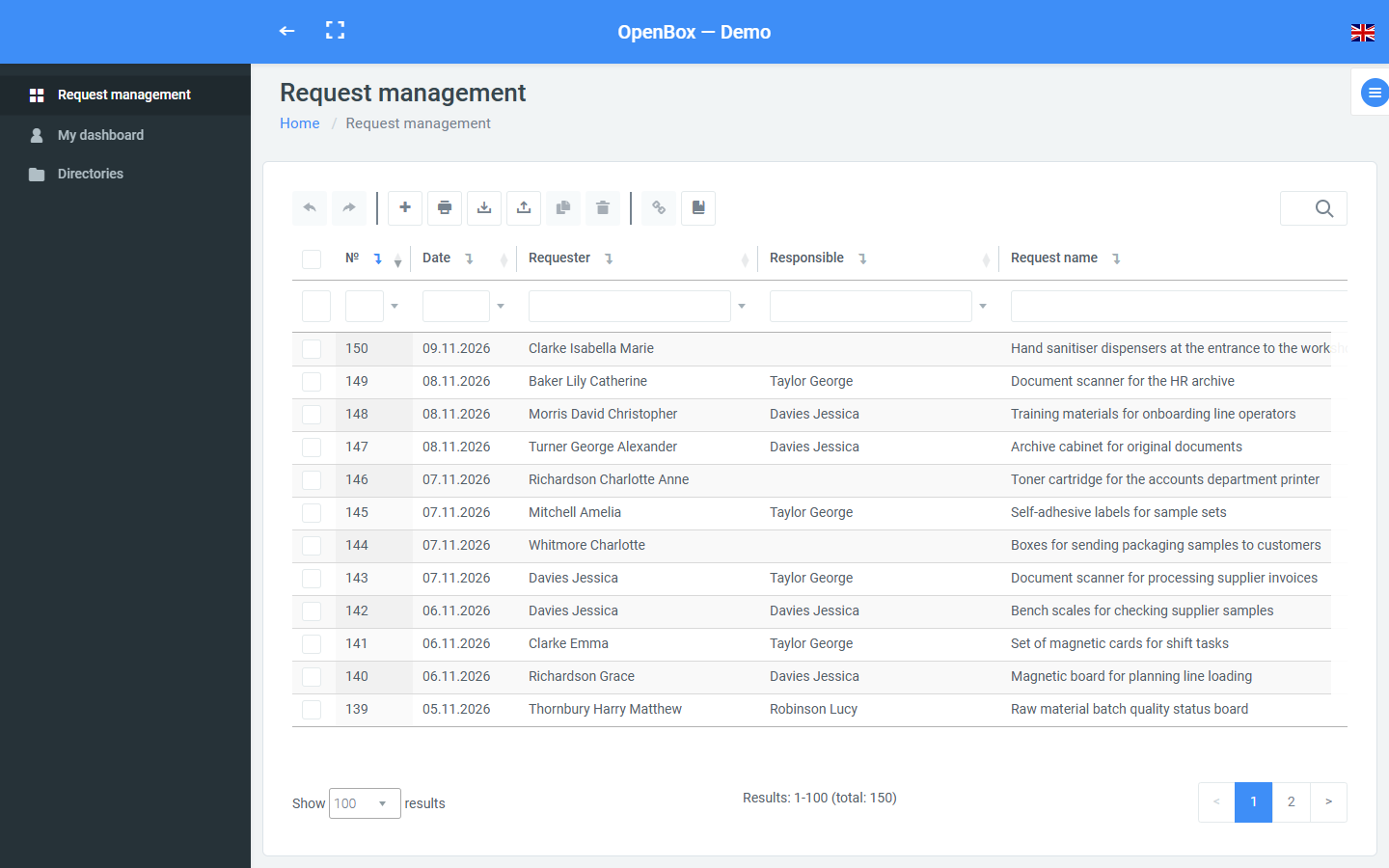
In OpenBox, departmental requests are collected in one register. An employee specifies the need, and the Procurement team works with the shared record, adding information about the Procurement and delivery. The information remains linked to the request rather than being distributed across personal correspondence.
- 1. The Need Is Recorded in a Card
The requester, department, name, quantity, unit of measurement, and note help convey the initial data. For example, the maintenance department can describe the required item and delivery conditions before the procurement specialist starts looking for a supplier. The completeness and accuracy of this information remain the responsibility of the process participants.
- 2. The Person Responsible and Status Are Available in the Shared Register
Each request has a person responsible and a current status. Employees see the records available to them within the configured permissions. This allows them to check the work status in the program, while the manager can review requests using search, filters, and sorting.
- 3. Procurement and Delivery Are Linked to the Original Need
The contractor, invoice number, amount, delivery location, and delivery date are stored alongside the request. If arrangements need to be clarified or the work handed over to a colleague, there is a shared record to use as a starting point.
What Changes in Day-to-Day Work
The foreman creates a request with the necessary information. The procurement specialist takes it up and specifies the person responsible. After a supplier is selected, the record is supplemented with Procurement and delivery details, and the status is updated as the work progresses. The requester and manager have a shared point for checking the request status.
This process helps reduce information searches and repeated clarifications. It also creates a basis for analyzing disputed situations: the need and information about its execution can be found in the register, and the required selection can be exported for analysis.
At the same time, the program does not decide for the manager which Procurement is more important and does not automatically eliminate supplier delays. Priority rules and the necessary additional fields are agreed according to the company’s operations. The result also depends on how consistently employees register requests and update information.
See How to Organize Work with Departmental Requests
If you recognize your Procurement operations in the situations described, explore the “Request Management” solution. Its page shows OpenBox capabilities, the interface, the path of a request from creation to delivery, and the implementation process. You can also proceed to a program demonstration there.